
Skip to content

Work / 03 PropTech Platform / Product Experience

FLATR

Four jobs, met in the right order

A property portal rebuilt around the order a seeker actually moves in — search, place, the facts, and the moment an agent appears.

FLATR · Active product

01 The engagement

Flatr is a property technology platform designed to control the complete digital experience for property seekers, investors and agents. Imagio worked across the product experience, design system and digital architecture, including the main Flatr platform and AgentHub ecosystem.

02 The surface
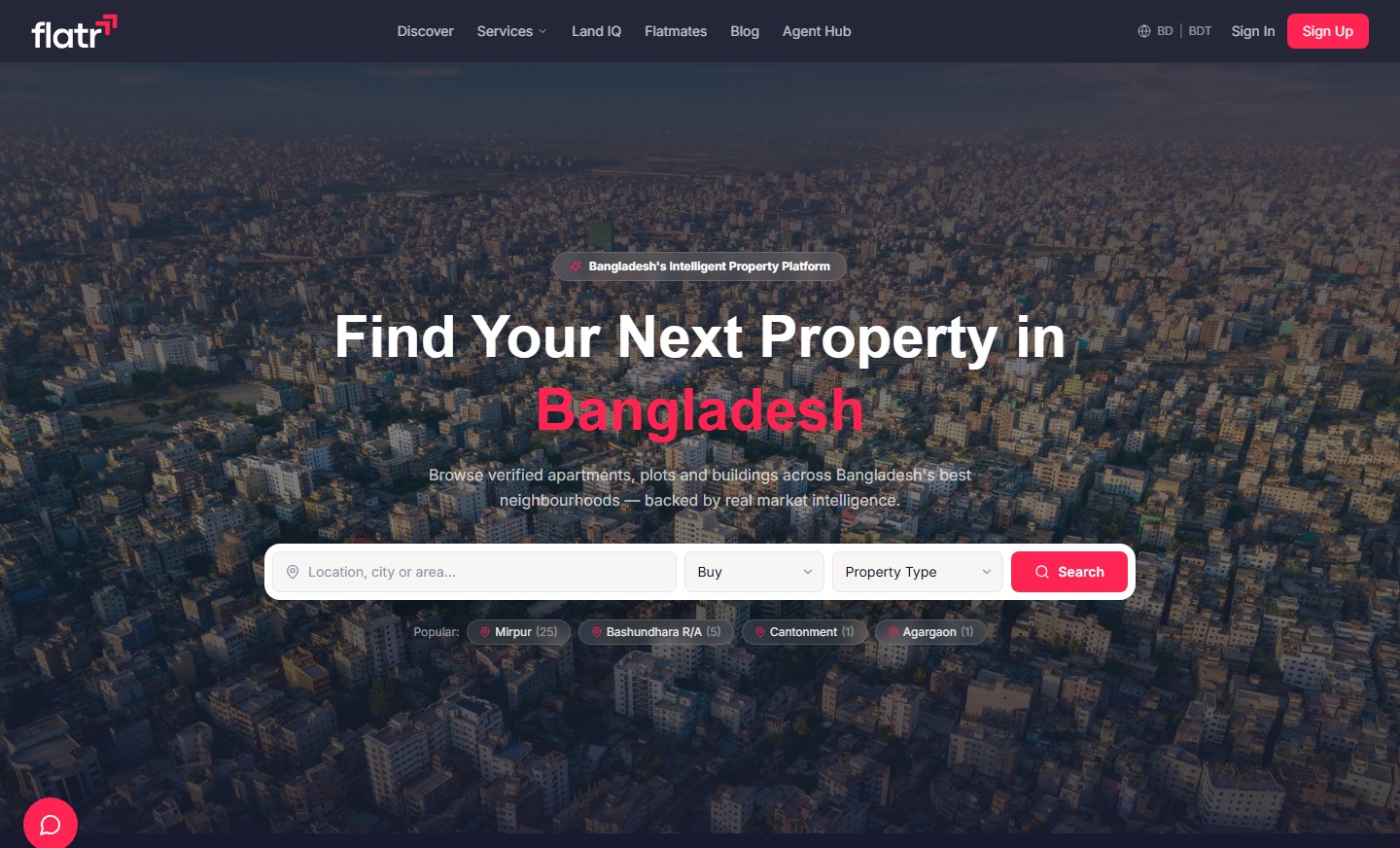
Screenshot of the live flatr.io home page: the flatr wordmark at the top left and a navigation of Discover, Services, Land IQ, Flatmates, Blog, Agent Hub, a language switch, Sign In and a red Sign Up button; below it an aerial photograph of a dense city at dusk under a dark blue sky, a pill reading “Bangladesh’s Intelligent Property Platform”, the headline “Find Your Next Property in Bangladesh” with Bangladesh in red, and a search bar with Location, Buy and Property Type fields and a red Search button.
FLATR — flatr.io
SCREENSHOT OF THE LIVE LANDING PAGE · 1440 × 872 · CAPTURED 30 SEPTEMBER 2026
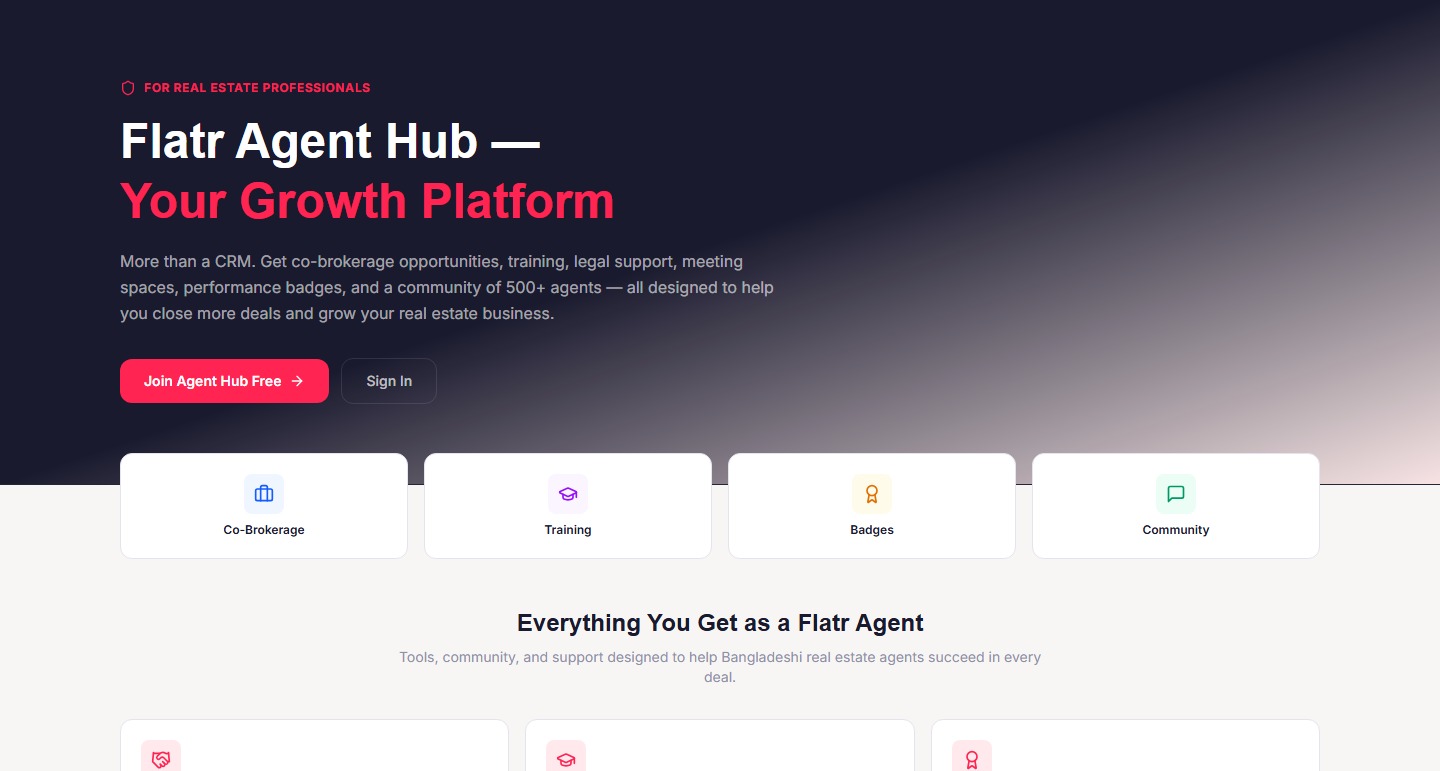
Screenshot of the live flatr.io/agenthub page: a dark hero with the small red note “For real estate professionals”, the headline “Flatr Agent Hub — Your Growth Platform”, a paragraph beginning “More than a CRM. Get co-brokerage opportunities, training, legal support, meeting spaces, performance badges, and a community of 500+ agents”, a red “Join Agent Hub Free” button and a “Sign In” button, and below four white tiles labelled Co-Brokerage, Training, Badges and Community above the heading “Everything You Get as a Flatr Agent”.
FLATR — https://flatr.io/agenthub
SCREENSHOT OF THE LIVE AGENTHUB PAGE · 1440 × 771, CROPPED FROM THE 1440 × 900 CAPTURE AT y = 129, THE TOP OF THE PAGE’S OWN HERO · CAPTURED 1 OCTOBER 2026 · PUBLISHED UNALTERED

03 The problem
and the idea

The problem. Search, location, property information and agent contact are four different jobs, and they are usually built as four different products that a seeker meets in the wrong order. The consequence is not a bad page; it is a portal that makes a person reassemble the story themselves, and an agent who works in a different language from the person they are helping.

The idea. Make property discovery feel guided rather than overwhelming. The four jobs are not four features — they are one product, and they should behave like it from the first tap to the first message.

04 The work

What we did,
in order.

MapNetworkFLATR.IOAGENTHUB

01 · The journey before the wireframeBefore anything was drawn, the route was written out as a sequence: where a seeker starts, what they need to know next, and where the supporting agent appears in that sequence and why there rather than earlier or later. The page list came afterwards, as a consequence of the route, not as its premise.
02 · One set of patterns, two sidesSearch, results, listing cards and detail views were designed once, as patterns, and both the seeker journey and the agent journey are built from them. An agent tool that had to invent its own layout would have produced a second design language inside one product; sharing the patterns is what keeps the halves recognisably the same place.
03 · Filters are a surface, not a formFilters are treated as part of the results pattern rather than as a control panel that happens to sit above it, because a filter the reader cannot see the effect of is a form, and a form does not help anybody decide. The state of a search is visible in the results it produced, at the size the results are read.
04 · The agent is a station on the routeThe point at which a person hands over to an agent is designed as a moment in the seeker’s journey, with its own context — what has been looked at, what has been asked — rather than as a contact form reached from a menu. That is what lets the agent side of the product do its job without becoming a second front end.

05 Craft & sequencing

The decisions,
and why.

Why a journey and not a sitemapA sitemap describes where the pages are; a journey describes what a person is trying to do. Designing from the second makes the first follow, and it makes the moments worth arguing about — where the agent appears, what a result has to say before it is worth opening — visible early enough to be argued about.
Why the card is the smallest unit of trustOn a property portal the listing card is the product. Price, place, and the facts that decide whether to open it — every field that is not a reason to open the listing is a field that makes the ones that are harder to see.
Why the system is the deliverableA marketplace changes shape every quarter. A set of screens will not survive that; a set of patterns usually will, which is why the interface architecture and the direction of the design system were set alongside the journeys rather than after them.

06 The scope

The part we held

Product and experience design; end-to-end seeker flows; interface architecture and design-system direction across the discovery and agent journeys.

ClientFlatr
StatusActive product

07 Through the method

Observe. Think.
Imagine. Launch.

OBSERVESearch, location, property information and agent contact are four jobs built as four products — so the person doing one thing is made to meet them in the order the org chart happens to have.
THINKThe consequence is a portal that makes a visitor reassemble the story themselves. The seeker and the lister are two audiences for one transaction.
IMAGINEMake discovery feel guided rather than overwhelming: one product from first tap to first message.
DESIGNThe card as the smallest unit of trust, and a route the person can follow — address and place carry the story, not cards that decorate the search.
BUILDOne set of patterns across both sides, filters treated as a surface rather than a widget, and the agent given a station on the route.
TESTThe deliverable is the system, not the screens: the relationship between seeking, finding, evaluating and moving is specified before the interface is styled.
LAUNCHActive product. Live at flatr.io.